
What Is an Enterprise Browser?
This slide deck by Nathaniel Scriven, examines the security vulnerabilities inherent in using consumer-grade browsers for enterprise work. Because modern employees spend the majority of their workday in the browser, the unrestricted Document Object Model (DOM) leaves sensitive corporate data exposed to scripts, AI agents, and unmanaged, auto-updating extensions. Traditional security solutions like VDI, CASB, and GPOs fail to provide visibility or control inside the browser itself, a blind spot that is worsening with the adoption of protocols like TLS 1.3 and ECH. To close this gap, the presentation advocates for adopting purpose-built enterprise browsers that embed security directly into the rendering engine, enabling real-time DOM redaction, strict data access policies, and granular extension governance.
by Nathaniel Scriven | View Presentation
Tackling Config Drift and Compliance Using Automation
The slide deck by Matt Vitale outlines how to combat inevitable network configuration drift by establishing a single "Source of Truth" defined by structured data rather than relying on manual audits. It details a three-step automated compliance loop: defining the standard, comparing it to structured running configurations, and acting via automated alerting or remediation. The presentation advises starting small by automating a single, low-impact compliance check and notes that AI should only be used as a first-draft accelerator for writing rules, not a replacement for human network knowledge.
by Matt Vitale | View Presentation
Hunting Configuration Drift: How WEC Uses Nautobot to Automate Network Compliance
This presentation explores how WEC uses Nautobot to automate network compliance and combat configuration drift. Presented at the US Networking User Association, it details WEC's journey to overcome manual resource constraints and inaccurate documentation by establishing a trusted Single Source of Truth (SSoT). The deck outlines WEC's five-step automation process to synchronize data and create an intended-state model, while also highlighting future initiatives like enforcing Golden Configuration standards and applying these principles to radio network planning.
by Gunther Krause and Zach Biles | View Presentation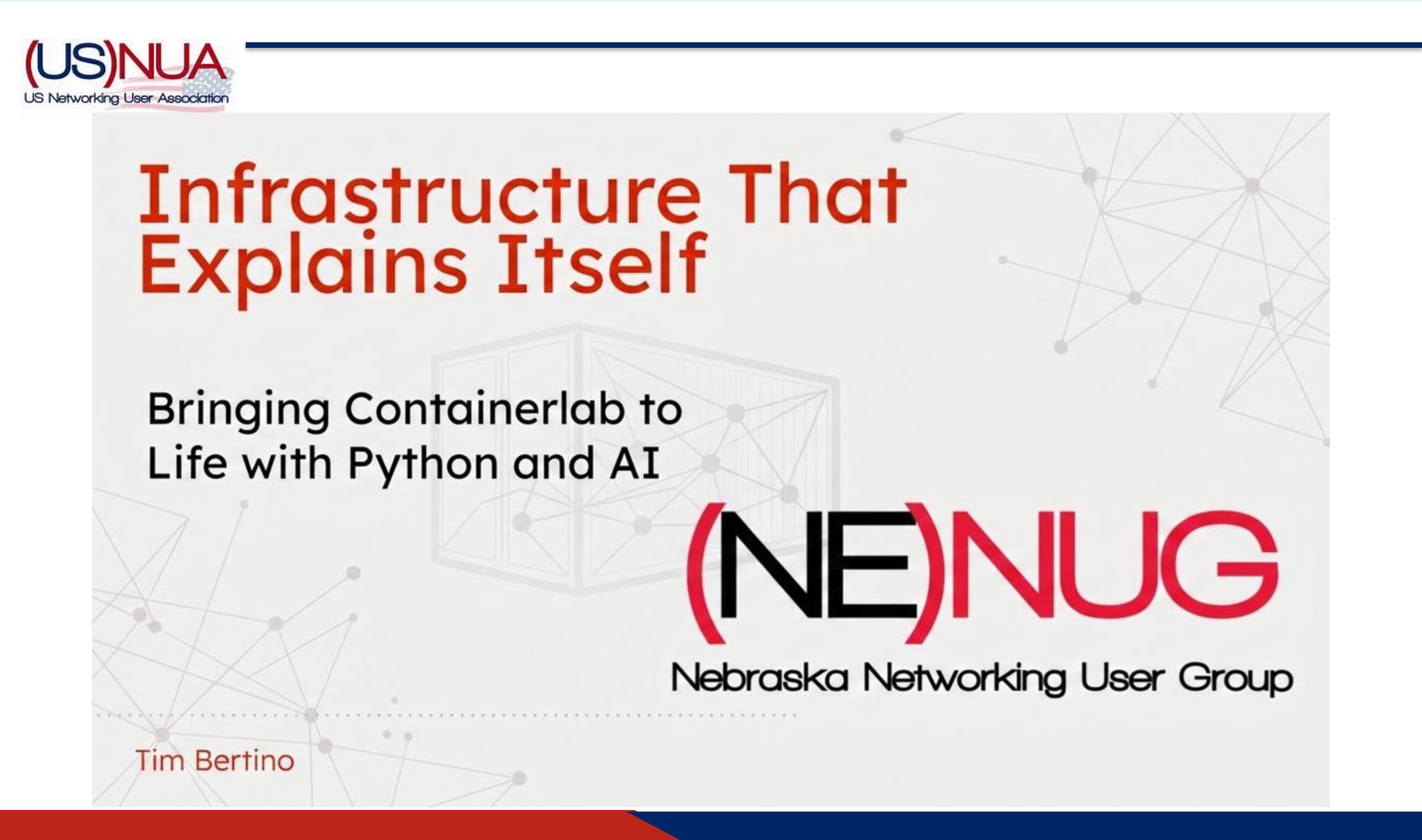
Infrastructure That Explains Itself - Bringing Containerlab To Life with Python and AI
This presentation by Tim Bertino explores how to build self-explaining network infrastructure. Presented for the US Networking User Association, the talk contrasts the high costs and complex setups of traditional hardware labs with the lightweight, reproducible nature of Containerlab. By utilizing Infrastructure as Code via YAML and open-source routing suites like FRRouting, engineers can quickly deploy and test networks to gain confidence before production. However, analyzing massive amounts of CLI output and logs often results in a high cognitive load, as understanding the network shouldn't require assembling a puzzle. To solve this problem, Bertino introduces his creation, NetCanvas, and its "Story Engine," which leverage Python for automation and AI to translate complex network logs and state changes into clear, understandable narratives. Ultimately, the presentation emphasizes that engineering should remove barriers, reduce cognitive load, and empower professionals to confidently build what they need
by Tim Bertino | View Presentation
The Next Gen Network Engineer (NGNE) for 2026
This Presentation outlines a framework to help network professionals navigate industry disruption. It emphasizes that network operations are increasingly downstream from software development, requiring new skills. The NGNE curriculum provides a tiered learning path, progressing from foundational networking to advanced topics like Linux, DevOps, cloud networking, and Kubernetes. Additionally, a major focus is placed on integrating Artificial Intelligence as "digital coworkers," which highlights the need for clean data and continuous, proactive technology evaluation. Ultimately, the presentation champions continuous personal learning alongside broader organizational evolution.
by Scott Robohn | View Presentation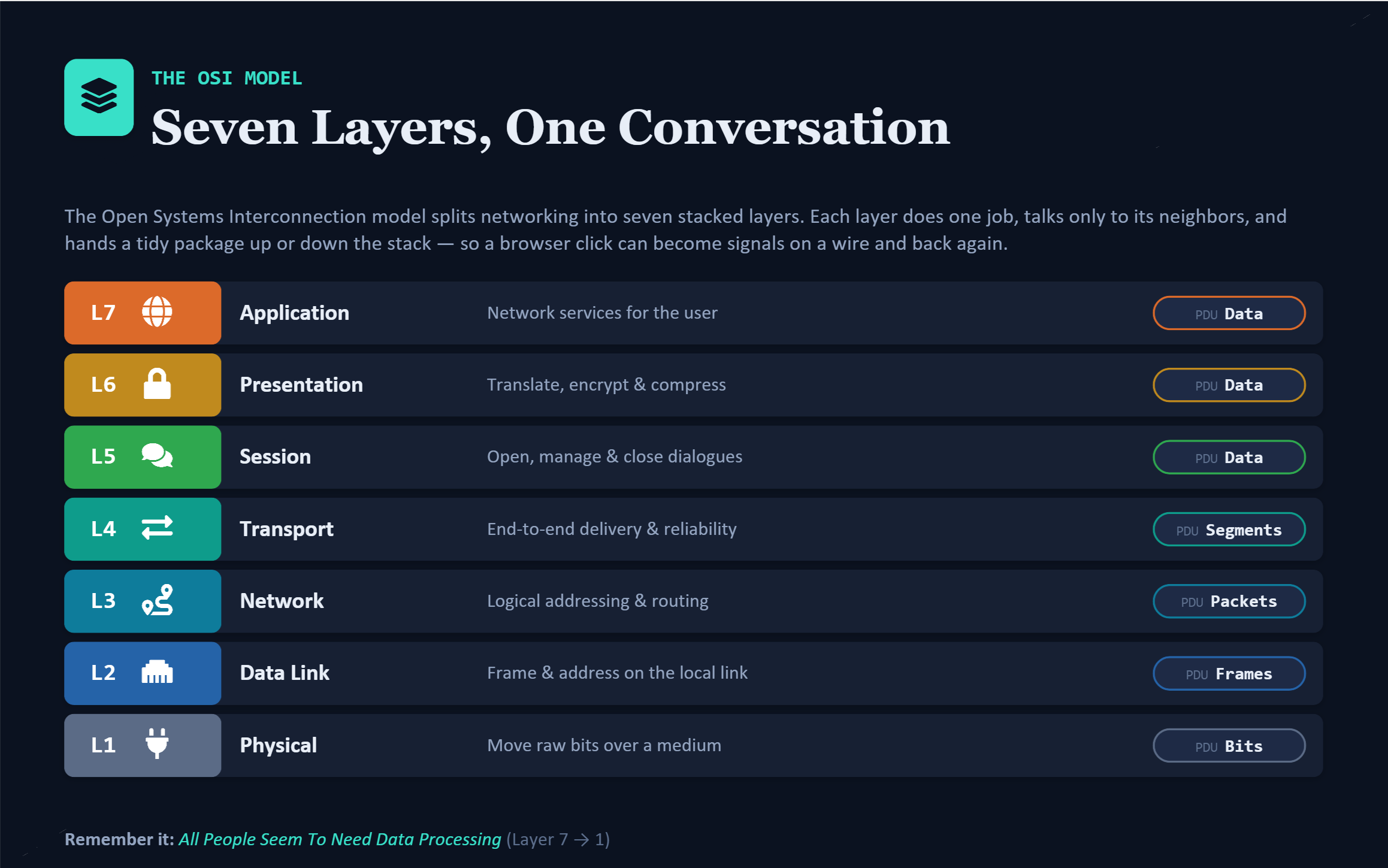
Everything but AI
This presentation by Dane Adams focuses on the seven-layer OSI model. The presentation thoroughly explains how network data is processed, moving from raw bits at the Physical layer (Layer 1) up to user-facing network services at the Application layer (Layer 7). It outlines the specific functions, Protocol Data Units (PDUs), and key protocols of each layer , and grounds these concepts in reality by showing how data encapsulation appears in a Wireshark packet capture.
by Dane Adams | View Presentation
Quantum Networks: The Next Frontier
This presentation by Jim Ricotta highlights quantum networking as a foundational infrastructure shift that distributes entangled photons rather than classical bits. Because quantum states cannot be copied and observing them destroys the entanglement, these networks provide physics-based security that is immune to future quantum computer decryption attacks. Key commercial and defense applications include Quantum Secure Communications (QSC) to protect critical data, Quantum Position Verification (QPV) to prevent GPS spoofing, linking quantum processors to scale computing power, and distributed quantum sensing for enhanced measurement precision. Driven primarily by the urgent need for future-proof security, quantum networking is currently transitioning from research labs into real-world deployments where it will evolve alongside, rather than replace, classical network infrastructure.
by Jim Ricotta | View Presentation
The Network Didn't Change. The World Around It Did
This presentation by Chris Sass highlights that while enterprise networks themselves remain the same, they are being overwhelmed by hidden AI features silently deployed through SaaS updates. These "agentic" workflows and AI-driven systems generate massive, continuous network traffic that bypasses formal IT change management and renders existing dependency maps inaccurate. Simultaneously, enterprise IT faces severe hardware supply chain delays and doubled costs because hyperscaler AI build-outs are consuming available fabrication, memory, and power capacity. To adapt, organizations must immediately audit their top SaaS applications for default AI features, extend hardware refresh timelines by 18 months, and use DNS logs to uncover undocumented "ghost" applications operating on their networks.
by Chris Sass | View Presentation
AI-Driven Network Automation
This presentation explores best practices for utilizing AI agents to build tools for network automation. It begins by explaining the foundational mechanics of AI coding architectures, distinguishing between Large Language Models functioning as statistical prediction engines and AI agents acting autonomously with memory and execution capabilities. The core mission focuses on building an open-source network digital twin plugin directly inside a Source of Truth, which allows engineers to model state and verify operational intent. To achieve this, the author outlines a structured development methodology involving the creation of hyper-detailed architectural specifications, the use of distinct AI personas for implementation and validation, and the integration of self-testing debugging loops. Ultimately, these agents are equipped with specific skills to autonomously deploy code via Docker, validate routing logic against real lab equipment using read-only proxy access, and generate comprehensive documentation for both human users and future AI systems.
by Eric Fetty | View Presentation
Wifi7 : Unicorn Farts, Black Magic and all the Gigabits
This slide deck provides a comprehensive overview of the Wi-Fi 7 standard, officially known as IEEE 802.11be. The presentation explores major technological enhancements designed to achieve Extremely High Throughput for real-time applications like virtual reality and cloud computing, including 320MHz wide channels, 4K QAM, Multi-Link Operation (MLO), and preamble puncturing.
by Allyn Crowe | View Presentation
Navigating Your Tech Career
This presentation from the US Networking User Association provides strategic guidance on navigating a tech career across three primary stages. For those in their early career, the advice emphasizes focusing heavily on personal growth, keeping an open mindset, and making connections, rather than fixating on job titles or initial salary . When seeking raises and promotions within a current organization, professionals are advised to closely track their successes, measure their overall scope and impact, and effectively sell their story to leadership . The presentation also recommends consulting tools like Glassdoor and salary guides to ensure requests are timed appropriately. Finally, when looking to transition to a new company, the presentation highlights the importance of leveraging your existing experience and leaning on warm networking introductions. Job seekers are encouraged to be intentional and concise, continuously learn, and network persistently with peers and recruiters.
by Alex Bowes and Zac Kallas | View Presentation
A Hiring Managers Perspective
Drawing from twenty years of experience, this presentation outlines a streamlined, six-stage hiring process designed to fix slow and indecisive recruitment systems . It highlights that poor job analysis causes up to 70% of hiring errors, making clear role definitions essential. During screening, managers should establish objective criteria and carefully calibrate automated tools to prevent bias. The author also emphasizes embracing diversity in the applicant pool, which can boost innovation by 35% and increase the chances of financial outperformance by 25%. In the interview stage, evaluating both technical and soft skills is critical, as over 60% of future jobs will require soft skills. Furthermore, assessing cultural fit is vital because strong alignment can reduce turnover by 30-40%. Finally, to ensure fair and accurate decisions, the presentation advocates for standardized scoring rubrics—which can increase the predictive accuracy of candidate success by 50%—and the use of weighted evaluation matrices with multiple stakeholders to minimize post-hiring regret.
by Adam Van Slyke | View Presentation
Personal Branding Without The Cringe
This presentation explains how tech professionals can build a personal brand "without the cringe". It emphasizes that visibility and trust lead to opportunities, while technical knowledge and job titles alone do not. To build genuine credibility, professionals must define their message and audience before posting, translate complex tech into business value, and openly share their learnings and failures. The guide advises mastering just one platform and avoiding traps like trend-chasing or posting without a clear point of view. Ultimately, building a brand is about establishing trust at scale. To start immediately, you should write a one-sentence brand statement, choose one platform, and commit to sharing one useful insight every week.
by Mike Lossmann | View Presentation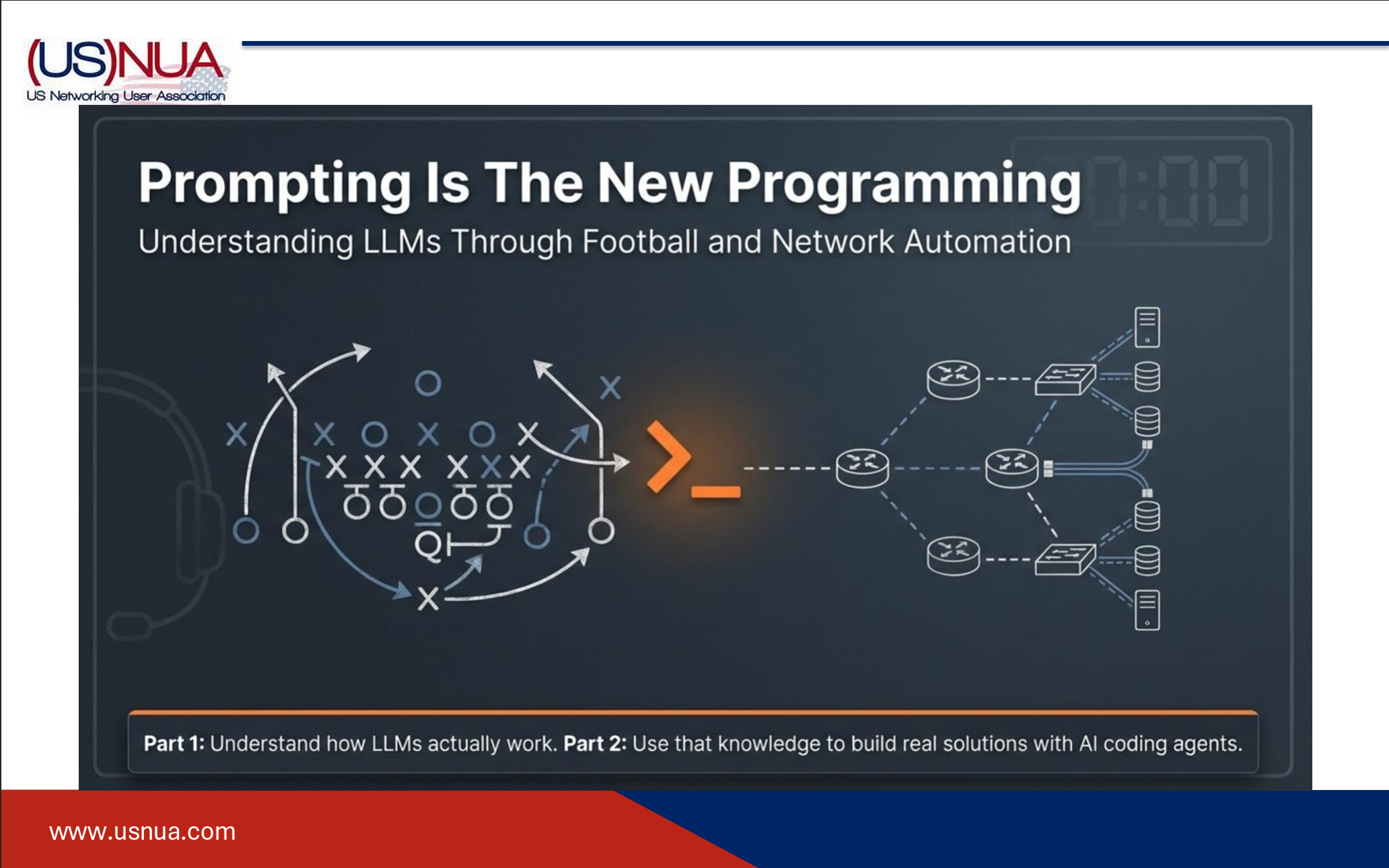
Prompting Is The New Programming: Understanding LLMs Through Football and Network Automation
This presentation uses American football analogies to explain how Large Language Models (LLMs) function and how to apply them to network automation. It equates technical concepts like model weights, temperature, and Retrieval-Augmented Generation (RAG) to a football coordinator's instincts, risk tolerance, and sideline scouting reports, respectively. Shifting to practical applications, the presentation highlights "Spec-Driven DevOps," a workflow that uses specialized AI subagents to prevent context loss during complex coding tasks. Finally, it demonstrates these concepts in action using the Model Context Protocol (MCP) and Agent-to-Agent (A2A) communication , showcasing a Webex chatbot that provisions networks from whiteboard images and an autonomous AI that discovers and monitors undocumented network topologies.
by Sean Mahoney | View Presentation
Strategies in Network Microsegmentation
This presentation highlights the necessity of segmentation for compliance, business unit isolation, and preventing malicious east-west network movement. The microsegmentation lifecycle involves transitioning from manual to automated processes by assessing assets, analyzing traffic via standards like sFlow and IPFIX, and developing validated rulesets. Implementation relies on discovering host context and utilizes frameworks like Endpoint Security Groups (ESG) and EVPN Group Policies for data centers, alongside Source Group Tags (SGT) for campus environments. To operationalize these strategies successfully, organizations must continuously refine rulesets and consider advanced machine learning platforms for adaptive security policies.
by Jayson Tobias | View Presentation
How to Confidently Ask for a Raise
This presentation provides engineers with practical steps for confidently requesting a salary increase, noting that individuals who ask often secure 10-15% more than those who remain silent. Engineers should build a strong case by quantifying their business impact and researching their market value, which currently averages $102K to $117K for network engineers in Pennsylvania. Timing is critical; employees should schedule a dedicated meeting following a major accomplishment or during budget planning. During the conversation, professionals must focus strictly on achievements rather than personal financial needs. Finally, always follow up in writing, and if declined, explore alternative compensation or ask for actionable feedback.
by Pat Allen | View Presentation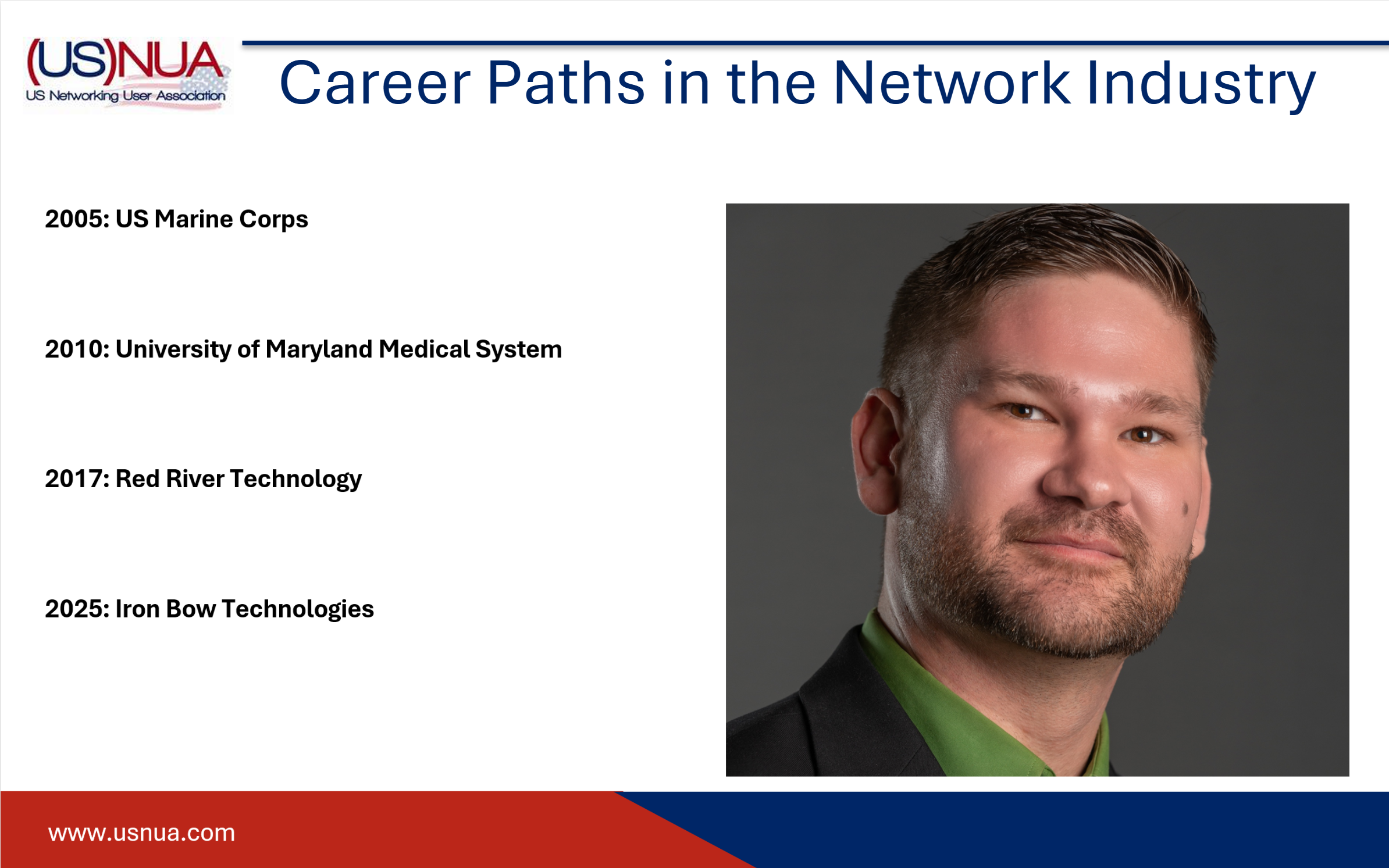
Career Paths in the Network Industry
Explores the reality of professional advancement beyond traditional corporate ladders. While many people only see a linear progression from a network engineer up to a CIO or CTO role , the industry actually offers a diverse array of alternative career tracks. These hidden paths include roles in professional services, service management, independent contribution, and sales and solutions engineering. To discover these opportunities, professionals are encouraged to utilize platforms like LinkedIn and YouTube , attend vendor conferences and user groups , and actively seek out their passion and community.
by Danny Finein | View Presentation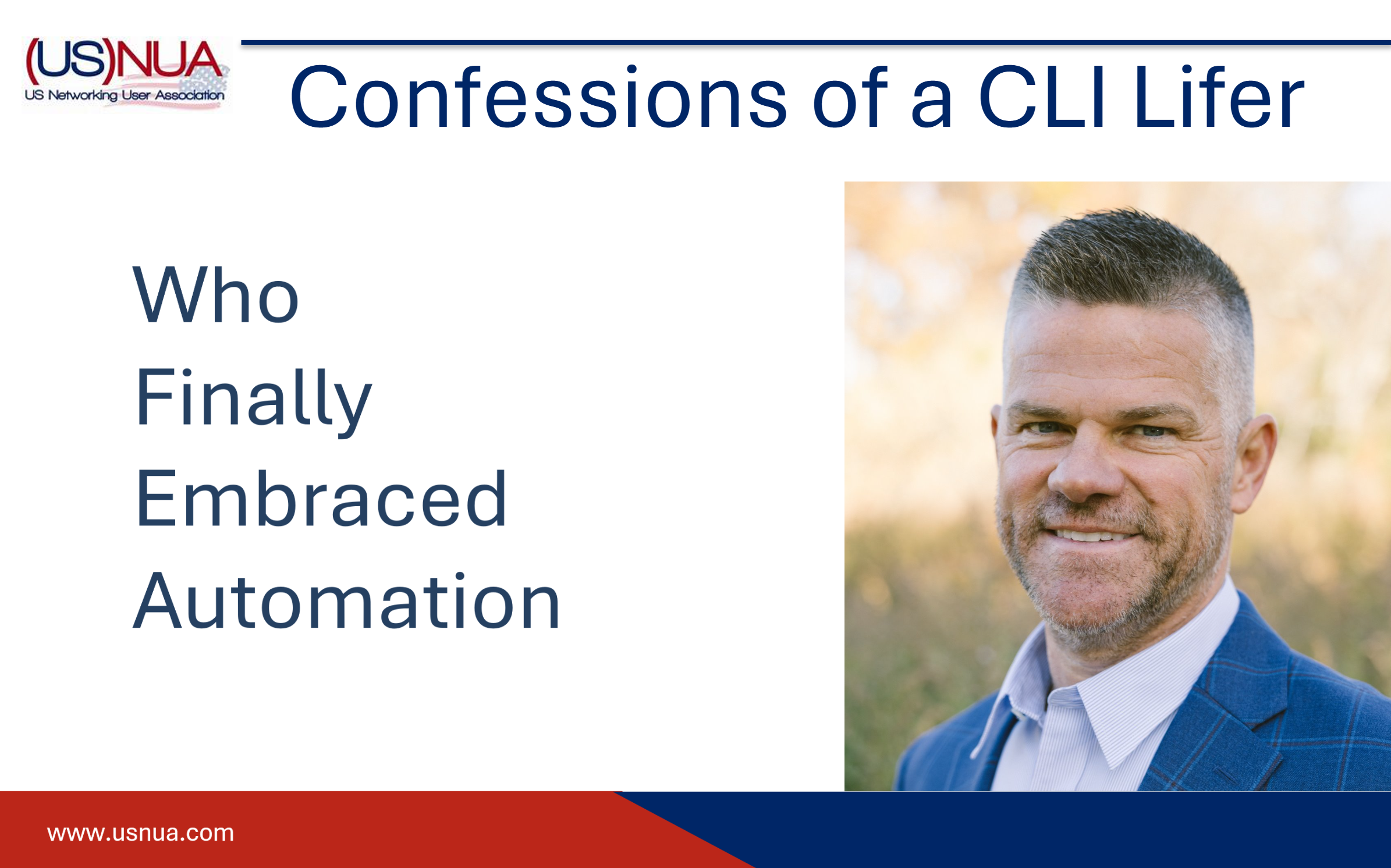
Confessions of a CLI Lifer
by Andy Lapteff | View Presentation
Engineering Your Promotion: What Network Pros Get Wrong About Career Growth
This presentation argues that career advancement requires more than just technical competence and hard work. It emphasizes that success is often given to those who are visible to leadership rather than solely earned through hidden effort. Professionals must clearly define their career goals, identify influential decision-makers, and explicitly ask for promotions. Crucially, employees should translate their daily tasks into measurable business impacts. By actively seeking mentorship, participating in cross-functional work, tracking achievements, and developing strong soft skills, individuals can strategically engineer their career growth.
by David Henderson | View Presentation
Salary Survey
The "2025/26 Tech Salary Survey Results" presented by Packet Pushers Interactive analyzes compensation data gathered from 418 IT professionals across 33 countries. The report highlights a global average total compensation of $163,832, though a notable geographic divide exists: US professionals average $197,106, while non-US respondents average $117,976. Earnings are heavily influenced by experience and education, with senior-level workers and doctorate holders commanding the highest pay. Certifications also play a crucial role, especially in Cloud technologies, where expert-level credentials can boost compensation by 43%. Despite varying pay scales, a majority of respondents reported feeling very satisfied with their salaries, generally viewing them as average or slightly above average compared to their peers.
by Drew Conry-Murray | View Presentation.png?width=364&height=471&name=Untitled%20(9).png "WAN Manager Survey")